Showing posts with label desserts. Show all posts

Friday, 26 July 2013

Cherry and Lemon Cream Slice Cseresznyés Lepény


This is a lovely soft buttery pastry jewelled with sweet summer cherries and flavoured with kirsch or cherry liqueur. It's usually served just dusted with icing sugar but this time I added some home-made lemon curd to give it a tangy creaminess. You could serve it with lemon curd mixed with lightly whipped cream too or vanilla cream. Whatever you do it will be a delicious afternoon treat.

100g butter
125g vanilla infused caster sugar (or plain caster sugar and few drops of vanilla essence)
pinch of salt
2 eggs
1 tsp kirsch (optional)
1 tsp baking powder
200g refined white spelt flour (or plain flour)
grated zest of a lemon or a lime
100ml milk
400g cherries, stones removed

Preheat the oven to 180C. Mix the butter and sugar until smooth, light in colour and fluffy. Add the salt, lemon zest, kirsch, eggs and mix well until very smooth. Mix the baking powder with the flour and add it gradually to the mix also adding a little bit of the milk each time until all completely incorporated. Grease and line a 20x30cm brownie tray, pour in the cake mix and spread the cherries on top. Bake in the oven for 40 minutes or until cooked through. Cool and slice, dust with icing sugar. I cut each slice horizontally and spread a little lemon curd in the middle before sandwiching them together again. But it would be lovely to serve it with some lemon curd flavoured whipped cream too.
 

Wednesday, 24 April 2013

Blueberry and Spelt Birthday Cake


I made this cake for our little one Leo's 2nd birthday last weekend. He loves blueberries and any cakes, so I wanted to make something special but not too sweet for him. He also has a bit of eczema problem and can't eat heavily creamy puddings, so I used creme fraiche instead of butter or cream filling. The sponge is a standard one I use for many recipes, you add the same number of tablespoons of water and sugar as the number of eggs you use and double number of tablespoons of flour. You can then reduce or increase the quantity as you wish. I learned it from a friend's Mum, she told me a little rhyme to remember it for the rest of my life :-) It goes like this: "Ahány tojás annyi víz, dupla cukor, dupla liszt" In this rhyme you might notice she adds more sugar (!) but I half this for my recipes these days. 

3 eggs, whites and yolks separated
3 tbsp water
3 tbsp caster sugar
6 tbsp wholemeal spelt flour (or plain flour)
1 heaped tsp baking powder
few drops of vanilla extract

For filling and decorating:
icing sugar
blueberry jam
300 ml creme fraiche
fresh blueberries
chopped pistachios


Preheat the oven to 180C. Beat the egg whites until stiff peaks form. Mix the egg yolks with the sugar until completely smooth and pale in colour. Add the water and vanilla extract and mix well. Add the baking powder and the flour gradually and mix well again. Using a wooden spoon, very gently fold in the egg whites so that all the air is incorporated and the sponge mix is light and fluffy. Pour into a lined 20 cm cake tin and bake for 30-40 minutes until cooked through. Let it cool on a wire rack then slice into two discs. Beat the creme fraiche with 3 tbsp icing sugar until it resembles soft peaks of double cream, but add more sugar if you like it sweeter. Spread the blueberry jam and the creme fraiche on one half of the cake, place the other half on top. Sprinkle the top with icing sugar, pile some more creme fraiche on top and arrange the blueberries in the middle. Sprinkle with the chopped pistachios and serve the remaining creme fraiche on the side.


Monday, 18 March 2013

Ízes Bukta


Bukta is a light and mildly sweet dough filled with firm jam and baked snugly in the oven to be shared with friends around the table. The most traditional jam to use is the creamy, smooth aromatic prune jam szilvalekvár. It's not easy to get hold of it in the UK and I was lucky that my husband bought me something similar in France on his last trip. It would be equally tasty to use any other type of jam that is not too runny. Or even whole fruits like blackberries instead of jam would be delicious. I made mine with refined (white) spelt flour, but it's easy to replace it with plain flour. Spelt is healthier, lighter and more digestible and I really liked working with the spelt dough. Serve this warm or cool with some home made vanilla sauce or custard or cream.

500g white spelt flour (or ordinary white flour)
1 packet (7g) dried yeast
50g icing sugar
60g butter
300 ml milk
2 egg yolks
pinch of salt

creamy smooth prune jam for filling (or other jam of your choice)
butter for brushing
icing sugar for dusting

Start by heating up the milk with the butter until melted and almost boiling, then let it cool to lukewarm temperature. This process of scalding the milk will make your dough lighter and mixed with the melted butter, easier to work into the dry ingredients. Sift the flour, sugar, salt, yeast into a bowl and mix well. Add the egg yolks, warm buttery milk and mix with a wooden spoon or a dough hook until you get a smooth dough that comes away from the side of the dish. Cover and allow it to double in size in a warm place. This takes about an hour. Take the dough and gently knead it over on a floured surface. Roll out to about 1cm thickness and cut it up to 8cm squares. Put a teaspoon of jam on each one and roll them up into a ball or cylinder shape, tucking the sides in. Place them snug into a greased 23 cm cake tin and brush with melted butter. Preheat oven to 180C. Let them prove until the oven is warming up. Bake until they are cooked through and golden on top. In my oven this took about 40 minutes and I covered the top with tinfoil halfway through to stop it colour too much. Let it cool in the tin and dust with plenty of icing sugar. Serve with cream or warm vanilla sauce.

Tuesday, 19 February 2013

Nigella's Lemon and Almond Cake


We all love lemon and almonds in our house and I often make this cake as it's simple and doesn't need too many ingredients. The recipe is from Nigella Lawson's 'How to be a domestic goddess'. 
It's still winter and the height of citrus season hence this cake made it to my blog even though it's not very Hungarian in origin, probably more Middle Eastern. Must warn you it has a lot of butter in it, but on the bright side it has hardly any flour. In fact I think you could probably substitute it with more ground almonds to make it absolutely gluten free.
You only need one bowl for mixing, it's quick and stays moist and delicious for days. We served it with creme fraiche and the saffron poached pears I posted earlier they pair up really well with almonds.

225g soft unsalted butter
225g caster sugar
4 eggs
50g plain flour
225g ground almonds
half tsp almond extract
grated zest and juice of 2 lemons

Preheat oven to 180C/gas mark 4. Cream together the butter and sugar until almost white. Beat in the eggs one at a time, adding a bit of the flour after each one. When it's all really well mixed, gently fold in the ground almonds, almond extract, lemon zest and juice. Pour the mix into a greased and lined spring form cake tin (21-23cm) and bake for about an hour until firm, cooked through and the testing skewer comes out clean. You may need to cover it with foil halfway through if your oven is too fierce and the top colours too much. When ready, let it cool, take it out of the tin and wrap in tin foil and it will keep for several days. According to Nigella this cake will be best left for a couple of days, but we tried it the next day. Dust it with icing sugar before serving with cream, creme fraiche, berries or whatever takes your fancy.

Monday, 11 February 2013

Vanilla poppy seed cake Mákos Pite


As long as you have a packet of poppy seeds on hand, this is an easy winter store cupboard cake. You need to grind the black poppy seeds with  a spice or coffee grinder before making the creamy poppy seed paste for the filling. A very popular pie-shaped (or square tin shaped) cake all over Eastern Europe, Germany, Austria and a really great afternoon treat with your tea or coffee. This is made with a quick shortcrust pastry and a creamy vanilla and lemon scented sweet poppy filling. Add dried fruit to the filling if you wish, sultanas, prunes, cherries or small pieces of quince jelly are delicious mixed in. Serve with a dollop of creme fraiche or whipped cream.

For the pastry:
300g plain or wholemeal flour
150g butter, cut into cubes
pinch of salt
2 tbsp sour cream or creme fraiche

For the filling:
150g ground black poppy seeds
50g sugar
50g semolina
200ml milk
1 tsp vanilla extract or scraped out seeds of a vanilla pod
grated zest of a lemon
1 egg white
1tbsp sultanas

1 egg yolk for glazing

Make the shortcrust pastry quickly by putting all ingredients into a food processor and mixing until a pastry ball is formed. If you are doing it by hand, crumble the cold butter and the flour together between your fingers until you get a fine crumble texture. Add the salt and sour cream and knead into a firm dough. Make the filling by heating the milk with the sugar and vanilla until almost boiling. Take it off the heat and add the ground poppy seeds, semolina, lemon zest, sultanas, stir until well mixed. Let it cool to room temperature. Beat the egg white until firm peaks form then gently fold into the poppy mix. Preheat the oven to 180C. Divide the pastry into two and roll out the first one to the shape of your greased or lined tart case or baking tin. I used a 24cm loose bottom tart case. Place the pastry in the tin, pour in the filling and roll out the other pastry to cover the filling. Press down along the edges and cut the excess pastry off neatly. Brush the top with the egg yolk and bake for about 40 minutes or until all the pastry and filling is cooked, check this with a wooden skewer. Let it cool and dust with icing sugar.   

Monday, 4 February 2013

Cardamom rice soufflé cakes Rizskók tortácskák


Rizskók or rizskoch is usually a sweet rice soufflé baked in a large baking tray in the oven, then cut up into squares and served with a drizzle of raspberry cordial or jam. It's the typical school dinner pudding and afternoon treat from my childhood and it was always delicious as it was. I wanted to improve the recipe by using nice arborio rice with one or two things I love with rice and milky puddings. An addition of ground cardamom and topping the cakes with cinnamon roasted red plum compote is just so much more wintry and warming. Using little cake moulds, cups, muffin or tart cases  make them look a lot more appealing, but it would be just fine in a tray or cake tin too. 

120g arborio risotto rice
500ml milk
25g butter
half tsp ground cardamom
half tsp lemon zest
few drops of vanilla extract
50g caster sugar
2 eggs, yolks and whites separated

Melt the butter in a pan, add the rice and stir it around gently so it's all coated. Add the cardamom, lemon zest, vanilla extract, sugar and gradually start adding the milk as if you were making a risotto. Try not to stir the rice too much, just move it around slightly, adding more milk as the rice soaks it up while cooking. It should be cooked but not mushy, a creamy texture with a scent of cardamom. Let it cool down. Preheat the oven to 180C. Beat the egg yolks and mix it with the rice when it is cool or just lukewarm. Beat the egg whites until stiff then gently fold it into the rice, making sure it stays airy and light. Fill your greased cake moulds with the rice mix or spread into a lined baking tray and bake for 20-30 minutes until cooked through and lightly coloured. Stick a wooden skewer into the centre, it should come out clean.
For the topping I cut 8 red plums into quarters, sprinkled with cinnamon and 50g sugar, mix and roast in the oven at 180C for 20-40 minutes depending on the ripeness of the fruit. It should be soft and the juices syrupy when ready. Drizzle this over the cakes and dust with icing sugar.


Wednesday, 23 January 2013

Cardamom almond twists


I have become a huge fan of Scandinavian baking and desperately trying to find a connection with Hungarian baking to fit in with this blog. Well both regions have an undeniable love of baked goods and seem to eat a lot of sweet pastries so that is it. Having discovered the scandi style cardamom scented dough that tends to often have an almond paste filling in the end product (check Ikea food halls if you have not tasted them before), I wanted to do more of the same flavour. These cardamom almond twists remind me of the Kringle wreath I made before Christmas, it is from the same book Scandilicious Baking. This is the first time I made a cold fermented dough, left to prove overnight in the fridge. The end result was a really easy to handle dough with the perfect texture, so I will try this again. Saves time having to wait around hours for the dough to prove. This recipe makes 20 twists and they freeze well too. Thaw them completely before eating and warm up in an oven for 5 minutes, they will be soft and fresh tasting, a great little bite to go with your coffee on a cold winter day. I took the last two post's pictures outside in the snow, it was such a treat afterwards to finish off the hot chocolate with one of these twists!

For the dough:
325ml whole milk
50g butter
500g plain flour
75g caster sugar
1,5 tsp ground cardamom 
2tsp fine sea salt
7g dried yeast
1 egg, beaten

Filling:
75g soft butter
50g ground almonds
50g marzipan (or Scandinavian almond paste if available)
50g caster sugar
3tbsp créme fraiche
1tsp vanilla extract
pinch of fine sea salt

To finish:
1 egg, beaten for egg wash
flaked almonds for sprinkling

To make the dough first scald the milk with the butter by heating it until almost boiling. Let it cool to lukewarm temperature. This according to Signe gives a softer finish to the buns. Sift the dry ingredients together, mix, add the beaten egg and the warm milk and knead until you get a good slightly sticky dough. Place in a large lightly oiled plastic bag in the fridge overnight to cold ferment. (I imagine you could prove the dough in a warm place for 1-2 hrs until doubles in size to replace overnight fermenting). When ready to bake, let the dough come to room temperature and in the meantime make the almond filling. Mix all the filling ingredients in a food processor until it is a creamy almond paste. Roll out the dough on a floured surface to a 30x50cm rectangle. Spread the filling evenly on one half length ways and fold the other half over (so now you have 15x50cm rectangle) pressing the edges down to seal in the filling. A little water might help sticking them down. Using a sharp knife cut the dough into about 20 strips. Pick them up one at a time, twist the ends in opposite direction 3 times, make a round shape, tucking the end under and placing them on a lined baking sheet. When all done, place them in a warm place to rest and rise for another 15 minutes. Preheat the oven to 180C, glaze the twists with a beaten egg, sprinkle with flaked almonds and bake for 20 minutes or until golden and cooked through and sound hollow when tapped on the base.


Monday, 21 January 2013

Cardamom and saffron poached pears


We eat a lot of poached pears, apples and plums in winter and try to ignore the tasteless imported berries and other summer fruit. Seasonal winter fruit such as pears tend to be rather under ripe on supermarket shelves but they lend themselves to poaching perfectly. In fact you can poach any slightly unripe fruit with a bit of sugar and warming spices. They transform our winter breakfast porridge into something really special. I make this saffron poached pear every week, it's quick with a delicious scent of cardamom and a fabulous deep yellow colour from the saffron, great with breakfast or add it to vanilla ice cream. I adapted the original recipe from Darina Allen, she makes it with tons more sugar to make it a scented syrup. For us that would just be too ridiculously puddingy for breakfast, so I only add a tablespoon of sugar to the poaching juices. This is perfectly enough as the pears also give it a natural sweetness. How does it fit in with the Hungarian theme? Poached or preserved fruit has always been part of our diet back home, there was little choice of fresh fruit in winter. Poached fruit has always had a bit of a plain and boring quality about them, mainly in the form of overcooked apple compote. But I discovered spices like cardamom, star anise, cloves, cinnamon bark, saffron can make a huge difference to flavour and colour. Adding red plums to any poaching fruit will transform the whole dish to a beautiful claret red. As you can tell I am a big fan of poached fruit and there will be more to come in this topic :-)

6 pears
500ml water
1 tbsp caster sugar
lemon rind and some juice
small pinch of saffron
6 cardamom pods, crushed

Bring the water, sugar, cardamom, few strips of lemon rind, tbsp of lemon juice and pinch of saffron gently to the boil, stirring until the sugar dissolves. Peel the pears with a potato peeler, cut them in half length ways, core them, leaving the stalks on. Place them into the poaching liquid cut side down and gently simmer for 10-15 minutes then turn over and simmer for the same time. The poaching time depends on the ripeness of the fruit. If the pears are softer and more ripe, they will take less time to poach. If you can easily insert a knife into the pears, they are ready. By this time the juices have also reduced to a sweeter more syrupy liquid and the pears taken on a deep golden colour. If the fruit takes longer to poach, keep an eye on the syrup ad top it up with a little boiling water if need to. When ready, cool it down and keep it in the fridge. Serve it with porridge, birchers muesli, yoghurt, chopped nuts or as a dessert with  ice cream and drizzle with chocolate.

Wednesday, 12 December 2012

Christmas poppy seed roll Mákos Beigli


As you wouldn't have Christmas without szaloncukor it's also traditional to have these sweet yeasty bread rolls filled with sweet creamy poppy seed or walnut paste. They are very popular around Christmas (Karácsony) and Easter (Húsvét) and generally any celebration times in the whole of Eastern Europe and also in Jewish cuisine. Having spent the past week at home with a sick toddler while desperately hoping to get fit for our fast approaching Christmas trip to Australia - to lift the Christmas spirits I had to make this Mákos Beigli and it turned out lovely. There is much anxiety around beigli making, I didn't find it difficult or time consuming and this was the first time I made it - my Mum has always done it for the whole family, including vast quantities of frozen supplies for us in the UK if we happened to spend the holidays here :-) I have based it on the tried and tested Horváth Ilona recipe, only changed a couple of things to make it quicker and easier for the dough to rise. This quantity makes 2 large or 4 medium size rolls.

For the dough:
500g plain flour
250g butter
2 eggs
50g caster sugar
20g fresh yeast (or 7g dried yeast, can add straight to dry ingredients)
200ml milk
pinch of salt

For the filling:
300g black poppy seed
200g sugar
300ml milk
vanilla pod (seeds scraped out) or few drops of vanilla extract
grated zest of a lemon
50g semolina
handful of sultanas soaked in a splash of dark rum


To make the dough sift the flour into a bowl with the salt, add the sugar and mix well. Warm up the milk a little until lukewarm. Mix 50ml milk with a teaspoon of the sugar and crumble the yeast into it, mix until creamy then add to the flour. Melt the butter into the rest of the warm milk and add this to the flour too. Knead it until well mixed and the dough comes away from the side of the bowl. Cover and leave in a warm place for an hour to rise and double in size while you make the filling.
Grind the poppy seeds together with the sugar using a coffee or spice grinder. Warm up the milk with the vanilla until boiling, take it off the heat and add the ground poppy seed-sugar mix, lemon zest, semolina, rum soaked sultanas with their liquid. Mix well and let it cool.
Take the dough and divide into 2 or 4 pieces depending on the size of the beigli you want to make. Roll each one out to a rectangle shape to about 5mm thickness, spread the filling evenly on top, leaving the edges clear. Fold the short sides in slightly to keep the filling in, then roll it up starting from one of the long sides. Place on a baking sheet, fold side down, leaving a generous gap between the rolls. Preheat oven to 180C/gas mark 6. Brush the pastry with a beaten egg and leave it to rest until the oven is ready. Pierce the sides in several places with a sharp fork, this will prevent the rolls from splitting. Bake for 25-30 minutes until golden colour and cooked through. Cool and dust with icing sugar.

Tuesday, 11 December 2012

Chocolate cream gateau Lúdláb torta


One of my absolute favourites from childhood. Lúdláb torta is a rich triple layer chocolate cake with a thin cocoa sponge base, a deep chocolate cream filling dotted with dark rum soaked cherries and covered with dark chocolate topping. I made this cake for a friend's birthday couple of weeks ago and managed to save a slice for the picture. All the girls loved it and the cake tin was licked clean before I even put it on a cake stand! But the biggest compliment came from our friend's dad Richie who has eaten many cakes in his life, he said it was THE best chocolate cake he had ever had! How brilliant is that? As I didn't scrimp on proper dark chocolate, cream and butter, it is definitely a cake for days when you are not counting calories!

For the sponge base:
2 eggs, yolks and whites separated and egg whites beaten until peaks form
4 tbsp caster sugar
4 tbsp plain flour
2 tbsp cocoa powder
2tbsp water
1tsp baking powder
few drops of vanilla extract

For the filling:
500ml double cream
400g caster sugar
500g unsalted butter, cut into small cubes
200g dark chocolate (50%) broken into small pieces
few drops of vanilla extract
350g frozen morello cherries, thawed, drained and soaked in a couple of tbsp dark rum

Topping:
100g dark chocolate (50%) broken into small pieces
1tbsp flavourless oil (sunflower or groundnut)

Preheat oven to 180C/gas mark 6. To make the sponge, cream together the egg yolks with the sugar. Add the vanilla extract, cocoa powder, water and mix until smooth. Gradually add the flour and baking powder, mix well then add the beaten egg whites, folding in gently so it adds air to the sponge mix. Pour into a greased, lined 23cm cake tin and bake in the oven for 15-20 minutes, until cooked through. Cool it down before putting the filling on top.
Make the filling by warming the double cream with the sugar until gently dissolves, then bring it to the boil for a few minutes. Take it off the heat, mix in the dark chocolate, stirring until completely smooth and dissolved. Add the vanilla extract and stirring continuously, add the butter cubes until all melted and smooth. Let it cool down and stick it in the fridge for half an hour to thicken slightly. Mix in the rum soaked, drained cherries and pour it over the sponge base. I left the base in the cake tin and poured the thick creamy filling on top, then put it in the fridge until completely set. I left it there overnight and it was perfect by the morning. For the topping, melt the dark chocolate in a bowl over simmering water, making sure the bowl doesn't touch the water. When melted, mix in the oil until smooth and pour over the cake. Smooth it with a spatula or make rough peaks as you wish. You could sprinkle chocolate shavings on top to make it more of a celebration cake.


Thursday, 29 November 2012

Cherry and Almond Advent Wreath


In Hungary Advent wreaths are normally made of fir, pine cones and 4 candles for the 3rd Sunday before Christmas, to light a candle each Sunday and then the last one on Christams Eve. I was so happy to discover that people also bake them, in fact some bake one for each Sunday of Advent! I think it's a lovely thing to do and you could decorate it with small candles if you wish.
I based the recipe on the Norwegian kringle wreath from Scandilicious Baking and glad I did. The distinctive flavour of ground cardamom in the dough and the lightness of this sweet milky bread is fantastic. I added kirsch soaked dried sour cherries instead of sultanas as they go so well with the almond paste that is the filling for this wreath. The sugar crystals and almonds on top make it look really festive too.

For the dough:
300ml whole milk
75g butter
500g plain flour
1tsp ground cardamom
3/4tsp salt
7g dried yeast
1 egg, beaten

Filling:
50g dried sour cherries
3-4tbsp kirsch or cherry liqueur
150g marzipan 
75g ground almonds
50g butter
1tsp vanilla extract
1 egg, beaten
1/4tsp salt
2-3 tbsp caster sugar

To finish:
1 egg, beaten
flaked almonds
sugar crystals (I used Lidl's edible cake decorations) or crushed sugar cubes

Scald the milk by heating it with the butter until almost boiling, this will make the bread softer. Let it cool to lukewarm temperature. Sift together the flour, sugar, cardamom, salt and dried yeast and mix well. Add the beaten egg and the slightly warm buttery milk and mix it until you get a smooth dough that comes off the sides of the bowl. Cover and let it prove in a warm place until doubles in size, for 30-40 minutes.
Make the filling by soaking the cherries in the kirsch. Mix all the filling ingredients together (add sugar to taste) in a food processor until you get a creamy paste.
Roll out the dough on a floured surface so it is a long thin rectangle of about 15x60cm. Spread the filling evenly over the dough, drain the cherries and sprinkle these over evenly. Roll it up into a cylinder, starting from one of the longer edges of the rectangle, brushing the other long edge with a bit of water to help seal the pastry. Bring the two open ends together to form a wreath shape and pinch to seal them together. Leave to prove in a warm place for 20-30 minutes. 
Preaheat the oven to 200C/gas mark 6. Glaze the wreath with the beaten egg then sprinkle almond flakes and sugar crystals all over it. Bake for 30-40 minutes until golden brown and hollow sounding when tapped on the base. My oven is really fierce, so I had to cover it halfway with foil, but all ovens are different. Cool on a wire rack before serving. You can also make it in advance and freeze this wreath, in that case defrost in a low 150C oven for 20-25 minutes, then bake at 190C for 5 minutes.

Tuesday, 27 November 2012

Chocolate coated cherries and prunes


I didn't intend to make these sweets. They ended up being a by-product of the szaloncukor batches I was making yesterday, but actually they are really delicious and make great christmas presents! I had some leftover melted dark chocolate I was using for dipping the marzipan nuggets, and didn't want to waste them. I also had open boxes of dried sour cherries and soft stoned prunes. Remembering how nice the shop bought chocolate coated dried fruit can be, I quickly made a couple of handfuls of these little treats. You could use any dried fruit you prefer, golden sultanas, figs, cranberries or even nuts would also be great. I used Lidl's 50% dark chocolate, chopped and melted in a bowl over simmering water. Make sure the bowl doesn't touch the water though. Dip them with the help of a fork and cool on baking parchment. Put in the fridge for 30 minutes so it is properly set, then they are ready to box. I covered a cardboard box with christmas wrapping paper to turn it into a festive gift.

Saturday, 24 November 2012

Rákóczi Túrós Baked meringue cheese cake

Here is another good old curd cheese cake recipe. There are thousands in Hungarian baking! This one is a huge favourite with everyone and one of the staples you can get in any cakeshop. I have been planning to make Rákóczi túrós for a while, and recently found a Polish curd cheese/cottage cheese in Asda that is very similar to the one you get in Hungary. I was very excited to try it (Saddo). You could use ricotta too. This cake is named after the French trained János Rákóczi, the Hungarian royal master patissier. He created this cake for the 1958 World Expo in Brussels as part of a selection of Hungarian dishes to represent what is quintessentially magyar in our cuisine. Rákóczi's recipe has been changed and altered by many over the years to suit changing tastes, but I followed his basic original recipe as I think it is the best and tastiest of all. He suggests a lettuce pattern of meringue and apricot jam on top, which I think is very retro in its looks and takes too long to fiddle with. So I made a plain meringue topping that I drizzled with jam (using my new drizzling gadget I got from my aunt). You could add more filling or more meringue as you wish.

For the pastry base:
250g plain flour
60g icing sugar
2 egg yolks
grated zest of half lemon
100ml sour cream
pinch of bicarbonate of soda
pinch of salt

For the filling:
500g curd cheese (or strained cottage cheese, ricotta)
3 egg yolks
2 egg whites
200ml sour cream
grated zest of half a lemon
few drops of vanilla extract
100g icing sugar
4 tbsp semolina and more for sprinkling

For the meringue topping:
4 egg whites
150g caster sugar

Mix the pastry ingredients together until you get a shortcrust pastry type of dough and rest it for half an hour in the fridge. Preheat oven to 180C and roll out the pastry to about 5mm thickness and place in a baking tray, I used a 20x30cm tray with 3cm sides. It doesn't need lining and I cut the pastry to the size of the tray base. Prick it with a fork in several places. Bake it for 10 minutes, it doesn't need to be fully baked, just dry enough for the filling to go on top. Let it cool and make the filling.
Push the curd cheese through a potato mincer. Mix the egg yolks with the icing sugar until smooth an pale, add the vanilla etxract, curd cheese, sour cream, semolina, lemon zest.  Beat the egg whites until stiff and gently fold into the filling. Sprinkle the pastry with semolina and spread the filling on top evenly. Turn the oven down to 160C and bake it for about 20 minutes or until the filling has cooked through and when tested with a wooden skewer, it comes out dry. Take it out of the oven and make the meringue topping. Beat the 4 egg whites until stiff peaks form then add the caster sugar gradually. Spread the meringue mix on top of the cheese cake and bake it ready in the oven. I turned the oven up to 180C to start with to get that crisp meringue coat going, then turned it down to 140C to let the meringue centre bake a little but still keeping that lovely marshmallow texture. It really only needs to dry up a bit. When ready, cool it down and cut into squares or slices, drizzle with apricot jam.


Thursday, 8 November 2012

Chocolate dipped marzipan sweets Marcipános szaloncukor


In Hungary there is no Christmas without szaloncukor. These chocolate coated sweets are essential part of Christmas, you can buy them everywhere in large boxes and they are used as tree decorations. There are lots of different fillings, I chose one of my favourite which is a dark chocolate coated marzipan. Really quick and easy to make at home, they make great presents too, individually wrapped and if you feel adventurous you could hang them up the tree with some ribbon. 

To make about 500g or 35-40 sweets:
200g ground almond
150g icing sugar
few drops of almond extract
200g dark chocolate, chopped
about 40ml water

To make the marzipan, mix the ground almond with the icing sugar and gradually add some water until you get a paste that is easy to knead and mould into balls. Be careful not to add too much water as it will get too soft. Add a few drops of almond extract, knead it until well mixed, now you have your marzipan ready to mould. Form small bite size pieces with your fingers. Put the chocolate in a bowl and melt it over some simmering water, making sure the bottom of the bowl doesn't touch the water. When completely melted, dip the marzipan pieces into the chocolate with a fork and place them on baking parchment. When all done, put them in the fridge to set, this will take about an hour, after which they will be ready to be wrapped.


Friday, 2 November 2012

Tear and share walnut bread - Aranygaluska


Aranygaluska if translated literally means golden nuggets. Sweet, almost doughnut rich yeasty dough nuggets layered with sweet ground walnuts and melted butter. It's a course in itself all year round, except I made this one with star cookie cutters, so it's fit for the Christmas table. If you are making it for other occasions, just use an ordinary round or moon shaped cutter. Traditionally it's baked in a round tin and you are not meant to cut it but eat it in a tear and share style, dunking it into warm custard while it's still warm out of the oven. 

For the dough:
500g plain flour
25g fresh yeast or packet of dried yeast 
3 egg yolks
250ml warm milk
50g melted butter
50g icing sugar
pinch of salt

For the walnut filling:
Grind 200g walnuts to a coarse breadcrumb texture in a food processor. Mix it with 5 tbsp icing sugar. Prepare 100g butter.
 
Make a starter dough by mixing 100ml warm milk, crumbled yeast, teaspoon of icing sugar and 3 tbsp flour. Put in a warm place so the yeast can activate (if using dried yeast, you can leave this stage out and mix all ingredients in one go). After about 15-20 minutes the starter dough should be ready to mix with the other ingredients, adding the melted butter last. Work this dough until smooth and silky and air bubbles start to form while mixing, either with a dough hook in a mixer or by hand with a wooden spoon. Cover and leave in a warm place to prove and double in size, for about an hour.
Take the dough and knead it on a floured surface then roll it out to about 1cm thickness.  
Grease a 26cm loose bottom cake tin. Melt the 100g butter and have it ready in a bowl next to the sugary ground walnut. Start cutting stars out of the dough with the cookie cutter, dip each one into the melted butter then coat with the walnut mix. Place them into the tin snugly next to each other, creating 3 layers of nuggets by the time you used all the dough. Sprinkle the leftover walnut mix on top if there is any. If you don't want to dip every single nugget, then you can just brush each layer with the melted butter and sprinkle with the walnut mix. Preheat oven to 180C and let the cake rest and prove until the oven warms up. Bake for about 40-50 minutes or until it's cooked through. Take the side off the cake tin and serve it warm on the tin base.


Wednesday, 31 October 2012

Chocolate and Walnut Squares


These little nutty truffle like sweets which are also gluten free are lovely to have after dinner with coffee. They are incredibly easy to make as they don't need any cooking or baking. I found this recipe in a fellow foodblogger's recipe collection (Lilafüge) when I was looking for something small, simple and chocolaty to make last weekend.  I adjusted a couple of ingredients to match our UK availability. They are called Diós Kocka and usually served around Christmas, cut into very small squares as they are really intense in flavour, chocolate and walnuts. You could make it with almonds or hazelnuts too, whatever you have in the cupboard. The chocolate ganache on top could be used for various toppings for cakes, very easy to make.

250g ground walnuts
230g icing sugar
1 tsp vanilla extract
50ml water
10g butter
100g dark chocolate, chopped
100ml double cream

Grind the walnuts in a food processor until resembles breadcrumbs. Heat the sugar with the water and vanilla extract until completely melted and starts to boil. Add the walnuts and butter and stir this paste around on a lower heat for a couple of minutes. Pour the mix into a small (I used 20x15cm) lined tin or baking tray, smooth the surface and allow to cool. In the meantime prepare the ganache topping. Heat the double cream in a pan until it is boiling. Take it off the heat and mix in the chocolate pieces until it is really smooth and completely mixed. Pour this on top of the walnut paste, smooth it down with a spatula and let it cool. Put it in the fridge and leave it for a few hours, it will harden even more and will be really easy to cut into small bit size squares.


Wednesday, 24 October 2012

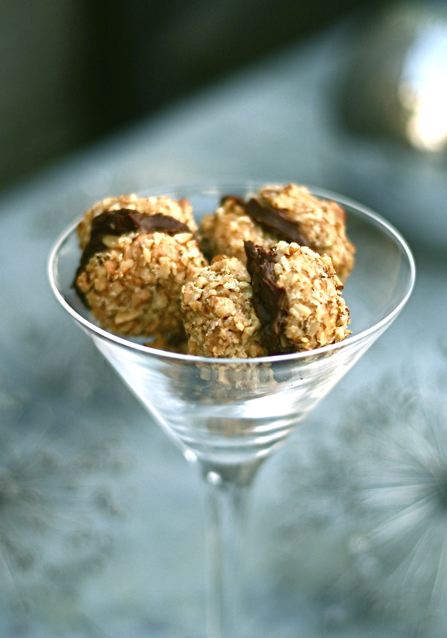
Csokis diós jojó Chocolate and Walnut yo-yo


I took a few shots of these biscuits and chose a less christmassy looking one as it is still only October... For those craving for some Christmas glitter there are the silver sprayed Allium heads and a candle in the background :-) These little bite size biscuits are a perfect addition to coffee, tea or a hot spiced drink. Chocolate and walnuts are main ingredients in a lot of sweet dishes, cakes and biscuits around the holidays in Hungary and having a welcome selection of sweet nibbles is very traditional when you are having friends and family around. Box them up they make a great home-baked present too!

For the biscuit base:
350g plain flour
200g butter
150g caster sugar
1 egg
2 egg yolks
few drops of vanilla extract
1 tsp rum
pinch of salt
grated zest of half lemon
1 tbsp milk

For the walnut crunch coating:
2 egg whites, gently whisked
250g chopped walnuts 

For the filling:
100ml double cream
100g dark chocolate, roughly chopped

Mix and knead all the biscuit ingredients until smooth. Cover with clingfilm and refrigerate for an hour. Warm the cream and the chocolate and stir until it's completely melted, then cool it down. When cool, put it in the fridge to chill then lightly beat to get it slightly more firm. Preheat oven to 180C. When well chilled and easier to mould, roll your pastry with your hands into lots of cherry size balls. Dip them into the egg whites then coat them with the chopped walnuts and place them on a lined baking sheet. Bake for 20-30 minutes or until the nuts become a golden toasted colour and the biscuit cooked through. Cool and start assembling the yo-yo's by sticking two discs together with a small teaspoon of chocolate cream filling. This quantity makes about 25 yo-yo biscuits.


Wednesday, 17 October 2012

Császármorzsa


One of my favourite treats from my childhood is Császármorzsa. It has to be the quickest after school nibble to make when you happen to have lots of children in the house. 
The name comes from the time of the Austro-Hungarian Monarchy where it was called Kaiserschmarrn (The Emperor's Crumble) and it was first made by the royal patissier for the Emperor Franz Josef I and his wife Sissi. It is a type of pancake batter and usually served with raspberry syrup(or cordial), fruit compote or jam in Hungary. In Austria we tried it in ski resorts where it's served with apple puree and is a delicious midday treat with a cup of hot chocolate. Traditionally it's cooked in a large pancake pan and made with plain flour. In Hungary it can also be made with semolina instead of flour and baked in the oven in a large baking tray.
I find it similar to drop scones or scotch pancakes but less fiddly as it's either baked whole in the oven or you just make 3 or 4 large pancakes in one go saving a lot of time standing around waiting for lots of mini pancakes to get done. In both cases the end result is roughly chopped up into small pieces, sprinkled with caster sugar and drizzled with runny jam or dunked into apple puree. It would make an excellent quick breakfast treat too. This quantity serves 4 people.

4 eggs
80g caster sugar
400ml milk
250g plain flour (you could use self raising flour to make the batter more fluffy) 
30g melted butter
flavourless oil for shallow frying
apple puree, runny jam, and more caster sugar for serving

Separate the eggs. Beat the egg whites until stiff peaks form. Mix the egg yolks with the sugar until smooth. Add the flour and milk, little at a time to make sure it's all well mixed without any lumps. Add the melted butter and mix well. Spoon and carefully mix the beaten egg whites into the batter. 
Heat a tablespoon of oil in a large pancake pan or frying pan, pour enough batter into the pan so that it will be enough for 3 or 4 thick pancakes, depending on the size of your pan. Fry it until golden on one side then turn it over with a spatula and fry the other side. When it's done, chop it up roughly with a wooden spoon put it on a plate and sprinkle with caster sugar. If you are baking it in the oven, preheat the oven to 200C. Heat up enough oil in a large baking dish that the bottom is generously coated. Pour all the batter into the dish and bake until golden colour and cooked through. Chop it up roughly into small pieces and sprinkle with caster sugar.


Friday, 12 October 2012

Almás rétes Apple strudel


There is a difference between strudels depending on where they come from. This is a typical basic pastry recipe for a Hungarian strudel that can be filled with hundreds of different sweet or savoury fillings. Apple, sweet ricotta, cherry, poppy seed paste are the most popular ones, you will see in patisseries. If you are lucky to have tried some home made rétes at your or some friends grandparents house then you may be familiar with some savoury fillings such as cabbage, potatoes and sausage or pumpkin. These strudels don't have the lettuce-work pastry topping like the Viennese strudels, so don't mix them up. 
The success of a good strudel pastry depends on the flour, which has to have a high protein content. If you use plain flour, some recipes recommend adding an egg to it just to raise the overall protein content. I have not tried this yet, but searched through all the flours in the supermarket, and found the very strong bread flour had the highest gluten content of all.   This gives the pastry its elasticity so it is easy to stretch so thin that you can read a book through it. Apparently. Kneading it by hand for a good 20 minutes also helps developing the right texture. I wouldn't say my kneading was of an experienced rétes-maker, hence the layers were less impressive when it came out of the oven. More practise definitely needed! (There are excellent tutorials for stretching strudel pastry on Youtube if you can't picture how to do it).
Of course you could use ready made filo sheets, but these are usually far too small and taste a bit like baking parchment - nothing like the real thing! Also traditionally, fat would be used instead of butter, but this really wouldn't be very popular here in the UK so I adapted the recipe.

For the pastry:
500g flour (with highest gluten content)
40g butter (and more for brushing the pastry before filling)
400ml warm water (mixed with a pinch of salt and tsp vinegar)

For the filling (which I would start cooking before starting on the pastry):
1kg dessert apples
200g granulated sugar
handful of sultanas
Cinnamon stick or tsp of ground cinnamon

Make the filling first so it has time to cool. Peel, core and grate the apples. Place in a heavy bottom pan with the sugar, cinnamon, sultanas and cook until soft, almost creamy texture and most of the juices have evaporated. Cool completely before filling the pastry.
Crumble the butter into the flour between your fingers or use a food processor for this, as if you were making a crumble topping. I guess mixing by hand is more traditional and may contribute to perfect strudel stretchiness... When all mixed and smooth, start adding the water until you have a soft dough. You need to knead this, softly stretching it and knocking it back for about 20 minutes by which time you should have a soft, elastic dough. Divide this in two (for two strudels) and cover them with a warm dish (I stuck a couple of pans in the oven to warm up while kneading the dough). Leave to rest for another 20 minutes. Preheat the oven to 180C.
Cover your dining table with a clean tablecloth and dust with flour. Start by rolling the first dough out as much as you can with a rolling pin then carefully start stretching it with the back of your hand. Stretch it as much as you possibly can but do not despair if you cannot read a book through it. You may have a few minor holes in the pastry but by the time you roll it up it will all disappear and look perfect.
Let it dry for a few minutes then brush generously with melted butter. Sprinkle with semolina or breadcrumbs under the filling to stop the pastry going soggy. Spread half the filling at one end of the pastry in a line and with the help of the tablecloth start rolling it up. It should be flat rather than a round roll shape. Once rolled you could cut the pastry edges clean off the end and sides if you need to. Place on a lined baking sheet and make the second strudel. When both strudels are ready, brush with a beaten egg and bake in the oven for 30-35 minutes or until golden and  the pastry layers are cooked through. Slice, dust with icing sugar and serve warm.


Wednesday, 3 October 2012

Mákos guba - Honey and Poppy seed Bread and Butter Pudding


Autumn is truly here with its damp and cold days and it naturally inspires me to cook more wintry dishes. There are a lot of store cupboard ingredients to choose from when there is less fresh fruit available, and the two most popular ones for toppings and fillings in sweet dishes in Hungary are poppy seeds and walnut. There is so much more to poppy seed than it being just a decoration sprinkled on cakes and pastries. Ground up and cooked with milk, sugar and spices it makes a delicious sweet and creamy paste, or ground and mixed with icing sugar you can sprinkle on various baked desserts. To ground poppy seed it is easiest to use a coffee grinder or a spice grinder. I mix it with icing sugar and grind it like that if a recipe calls for both. Mákos guba was originally made around Christmas time to symbolise wealth with the thousands of tiny seeds. It is still prepared as a celebration dish around the holidays. But these days many families have it all year round, it's a favourite with children too. This is a classic version of a traditional dish, but it can also be baked with custard, spices or orange and lemon zest added, served with cream or whatever takes your fancy. I love it traditionally served with a generous drizzle of honey. In Hungary you would make it with butter horn pastries (kifli), these are medium size yeasty dough pastries shape of a half moon. I will add a post on how to make these, they are really simple. This time I used a normal size baguette which is available everywhere.

1 normal size baguette (not too long and chunky)
450ml milk
vanilla pod or vanilla extract
80g black poppy seed
80g icing sugar
40g butter
honey

Preheat oven to 180C. Slice your baguette into 1cm discs and place them on a baking tray then put it in the oven to dry them out a bit. This pudding is usually made with slightly stale bread that soaks up the vanilla scented milk better. If you have a fresh baguette, drying in the oven helps to achieve this. Keep an eye on it so it doesn't start to toast. 
Butter a medium size baking dish and place the baguette discs in. Warm the milk up with a few drops of vanilla extract or the scraped seeds and pod from the vanilla. Do not let it boil. Pour the hot milk over the bread and let it soak. Turn it if you need to so it soaks up the milk all over. Grind the poppy seed and mix it with the icing sugar. Sprinkle this on top of the milky bread, turning it to coat the whole lot. Dot the top with pieces of butter and bake in the oven for 30-40 minutes or until warmed through and the bread is softened but slightly crispy on top.
Serve it with a good drizzle of honey.